This week on Four Tune Tuesday, we’re going old. Very old. Rather than our usual today-in-history framing, we’re taking a detour into the cylinder era — the format that preceded the 78rpm disc entirely, and the one that gave birth to the commercial recording industry in the first place. We open in 1891 with what is, as best as we can determine, the oldest cylinder in the UCSB Cylinder Audio Archive: a cornet solo by D.B. Dana, accompanied at the piano by bandleader Edward Issler, performing the “Cujus Animam” from Rossini’s Stabat Mater — recorded live, by hand, into a phonograph horn, with no possibility of duplication. Our second cylinder is a vocal piece from the same year, J.W. Myers singing “Bell Buoy” for the North American Phonograph Company — not a record label, but the chaotic network of thirty-three regional companies through which Edison tried, and ultimately failed, to dominate the nascent industry. From there, we turn to the violin — and to one of the more quietly fascinating chapters in recording history. Charles D’Almaine was the first person ever to record with a Stroh violin, an instrument invented in 1899 specifically to solve the problem that the standard violin posed for acoustic recording. We hear him first in 1899, before the Stroh, on a conventional violin in a solo arrangement of the “Miserere” from Verdi’s Il Trovatore — and then in 1904, after, on a joyful fiddle medley that includes, somewhere in the middle, a reel he apparently named after himself.
Stroh Violin
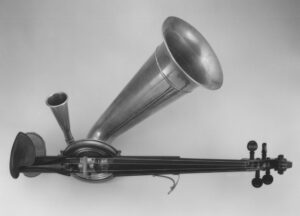
Violin. Patented by John M.A. Stroh. 1986.0858.01.