Cyanotypes: The Blueprints of Sunlight and Curiosity
If the daguerreotype was early photography’s dramatic leading actor—mercury fumes, silver plates, a flair for the theatrical—then the cyanotype was its quietly brilliant cousin who showed up with a stack of papers, a jar of chemicals, and the attitude of someone who fully trusts the sun to handle things.
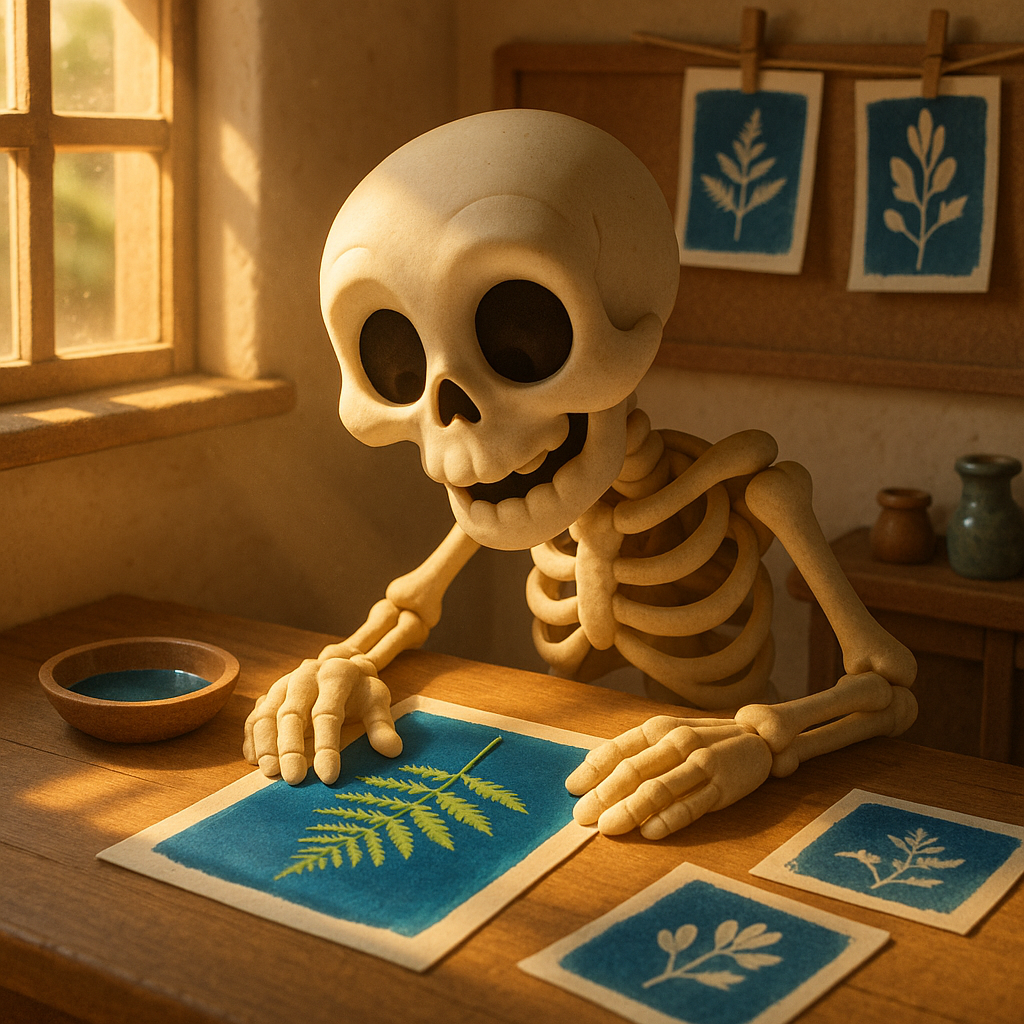
The cyanotype was invented in 1842 by Sir John Herschel, a man whose résumé reads like he collected new disciplines the way some people collect stamps. Astronomy? Yes. Chemistry? Of course. Inventing words like photograph and negative that shaped the entire medium? Naturally. And somewhere in the middle of all that, he gifted the world a photographic process that turned everything a rich, unmistakable blue.
It didn’t make Herschel famous—frankly, he already had that covered—but it made an indelible mark on photographic history and gave artists a color so iconic you can spot it from across the room.
Why Cyanotypes Are So… Blue
The magic of the cyanotype comes down to iron salts and sunlight—two ingredients that sound suspiciously like something a Victorian tinkerer might keep on a high shelf and forget to label.
When ferric ammonium citrate meets potassium ferricyanide, you get a photosensitive coating that reacts to UV light. You brush this greenish solution onto paper, let it dry somewhere dim, and suddenly your page is ready to record whatever you place on it: a fern, a feather, a photograph, or whatever random object you grabbed because the sun was finally out and you felt impatient.
Expose the paper to sunlight, rinse it in water, and watch as the image shifts from pale green to deep, velvety Prussian blue. As the water washes away the unexposed chemicals, the blues deepen, the whites brighten, and the whole thing settles into that classic cyanotype look: bold, graphic, and beautifully simple.
It’s chemistry, yes—but it feels a bit like watching a secret reveal itself.
How to Make a Cyanotype (Without Needing a Lab Coat)
The steps are almost suspiciously simple:
Coat your paper.
Set it in the sun with something on top.
Wash it.
Dry it.
Try not to shout “behold!” at unsuspecting bystanders.
Exposure time depends on the mood of the sun, your latitude, and whether the universe is feeling cooperative that day. Sometimes you get a crisp image in five minutes; sometimes you stare helplessly at a cloudy sky and question your life choices. Either way, the moment you rinse the paper and that blue appears, it’s magic every time.
Anna Atkins and the First Photographic Book
Cyanotypes might have stayed a clever lab experiment if not for Anna Atkins, a botanist who essentially said, “These are great—let’s use them to document the entire natural world.”
She created Photographs of British Algae: Cyanotype Impressions in 1843, the first book ever illustrated with photographs. Not engravings. Not etchings. Actual photographs. Page after page of delicate plant silhouettes in luminous blue. She wasn’t trying to make art, but she absolutely did.
Atkins turned cyanotypes into a scientific tool, an artistic medium, and a historical milestone all at once. Honestly, Herschel invented the process, but Atkins gave it a soul.
Photography for the People (and for Blueprints)
Cyanotypes had something going for them that daguerreotypes never did: they were cheap and forgiving. No darkroom necessary. No expensive equipment. No poisonous vapor cloud. Just chemicals, paper, sunlight, and a willingness to experiment.
This made the process irresistible to amateurs and hobbyists—Victorians who wanted to dabble in photography without buying into the more elaborate silver-based techniques.
But the really surprising legacy of cyanotypes came when engineers and architects realized the process was perfect for copying drawings. Thus the blueprint was born: white lines on a blue field, created quickly and cheaply, and duplicated as many times as needed. Entire cities quietly owe their existence to this humble blue process.
Meanwhile, Elsewhere in Photography…
While cyanotypes were quietly doing their thing, other photographic processes burst onto the scene with their own personalities:
Ambrotypes: classy portraits on glass, elegant but fragile—like someone who insists their drink be served in crystal even while camping.
Tintypes: portraits on thin iron plates, cheap, quick, durable, and wildly popular during the American Civil War. Soldiers carried tintypes like modern folks carry phone photos, except tintypes never crashed or needed charging.
These alternative processes weren’t competing so much as expanding the menu. Each one had its own look, its own quirks, and its own community of fans. Together, they helped photography shake off its early elitism and become something anyone with a bit of curiosity could try.
Why Cyanotypes Still Feel Fresh
Even in our digital age—where you can take 400 pictures of your coffee mug without breaking a sweat—cyanotypes have a hold on people. There’s something irresistible about letting sunlight draw an image. Something calming about the ritual. Something satisfying about blue that deepens as it dries.
It’s hands-on. It’s slow in a good way. It asks you to participate.
And above all, cyanotypes remind us that photography isn’t just about high-tech sensors and megapixels. At its heart, photography is still a conversation between light, chemistry, and human curiosity.