Social Impact and Iconic Images (1910s-1930s)
Something changed about photography in the early 1900s. It left the studio.
For decades, getting your picture taken meant sitting still in a controlled room while a photographer worked with heavy, stationary equipment. Then cameras like the Graflex and the Leica came along — portable enough to carry into a factory, a coal mine, a breadline. Suddenly a photographer could walk into the middle of someone’s life and record what was actually happening there. And what they found, more often than not, was hard to look at.
That shift turned photography into something it had never been before: a weapon against indifference.
Lewis Hine and the Camera as Evidence
Lewis Hine was a teacher before he was a photographer, and he never really stopped being one. He just traded the classroom for a camera and let his images do the lecturing.
Working for the National Child Labor Committee, Hine traveled the country photographing children at work — not “helping out at the family business” work, but ten-year-olds covered in coal dust sorting slate in Pennsylvania breaker rooms, and girls barely tall enough to reach the bobbins standing at textile machines for twelve-hour shifts. He composed these images carefully, almost always placing the child next to or inside the machinery they operated, so the scale of the thing was impossible to ignore. A child the size of a spindle. A boy dwarfed by the chute he was feeding.
These weren’t abstractions. They were evidence. And they worked. Hine’s photographs became central to the public pressure that eventually led to the Fair Labor Standards Act of 1938, which set minimum age requirements and hour limits for young workers.
He brought the same approach to Ellis Island, where he photographed newly arrived immigrants at a time when much of the American public viewed them with suspicion at best. Where newspaper editorials traded in stereotypes, Hine’s portraits showed individual faces — tired, hopeful, dignified. His later industrial work, including the well-known “Powerhouse Mechanic Working on Steam Pump,” did something similar for laborers, presenting physical work as something worthy of respect even when the conditions surrounding it were not.
Hine understood something that still matters: people respond to faces. A statistic about child labor is easy to set aside. A photograph of a specific child standing barefoot on a factory floor is not.
The FSA and the Face of the Depression
When the Great Depression gutted the American economy, the federal government did something unusual. Under the New Deal, the Farm Security Administration hired photographers and sent them out to document what was happening to rural and migrant communities across the country. The purpose was partly historical, partly strategic — these images were meant to build public support for relief programs by showing Americans what their neighbors were going through.
Dorothea Lange was the photographer who came to define the project. Her approach was intimate and unhurried. She spent time with her subjects, talked to them, and composed her shots to preserve their dignity even as she documented their hardship.
Her most famous image, “Migrant Mother,” shows Florence Owens Thompson sitting in a lean-to tent at a pea-pickers’ camp in Nipomo, California, two of her children turned away from the camera and pressed against her shoulders. Thompson was thirty-two years old. She looked much older. The photograph ran in newspapers across the country and almost immediately became a symbol of the entire Depression era — not because it was the most dramatic image Lange ever took, but because it captured something precise about what poverty actually looks like when it lands on a specific person.
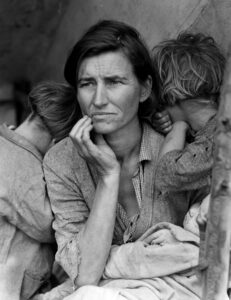
Lange’s other FSA work deserves just as much attention. “White Angel Breadline” shows a man in a crowd of Depression-era job seekers, his back turned to the others, leaning against a railing with a tin cup between his hands. “Toward Los Angeles” captures two men walking along a road toward the city, carrying everything they own. In each case, Lange turned a national crisis into a single human moment — something a viewer could hold in their mind and feel something about.
What These Photographs Actually Did
It would be easy to frame this story as “photography raised awareness,” but that undersells what happened. These images didn’t just make people aware of child labor or the Depression. They made people angry. They made people uncomfortable. And in several measurable cases, they changed policy.
Hine’s child labor photographs were used as direct evidence in legislative hearings. Lange’s FSA images helped sustain public support for New Deal relief programs at a time when political opposition to government spending was fierce. The photographs worked because they refused to let the viewer remain at a comfortable distance from the subject. A breadline is an abstraction until you see the expression on one man’s face in it.
Documentary photography in this period proved that a camera could be more than an artistic tool or a journalistic one. It could be an instrument of conscience. The photographers who did this work — Hine, Lange, and their peers in the FSA project — built something that outlasted any single image: the idea that showing people what is actually happening is, in itself, a form of advocacy.
That idea hasn’t gone anywhere.