When Sound Learned to Haunt: The Rise (and Fall) of the Phonograph Cylinder
We live in a world where music is weightless, invisible, and summoned with a thumb twitch. It’s efficient. It’s convenient. It’s also a little bloodless.
Before sound lived in clouds and algorithms, it lived in objects—fragile ones. Wax. Metal. Things that wore out, cracked, and failed. And one of the strangest, most beautiful of those objects was the phonograph cylinder: awkward, temporary, and utterly revolutionary.
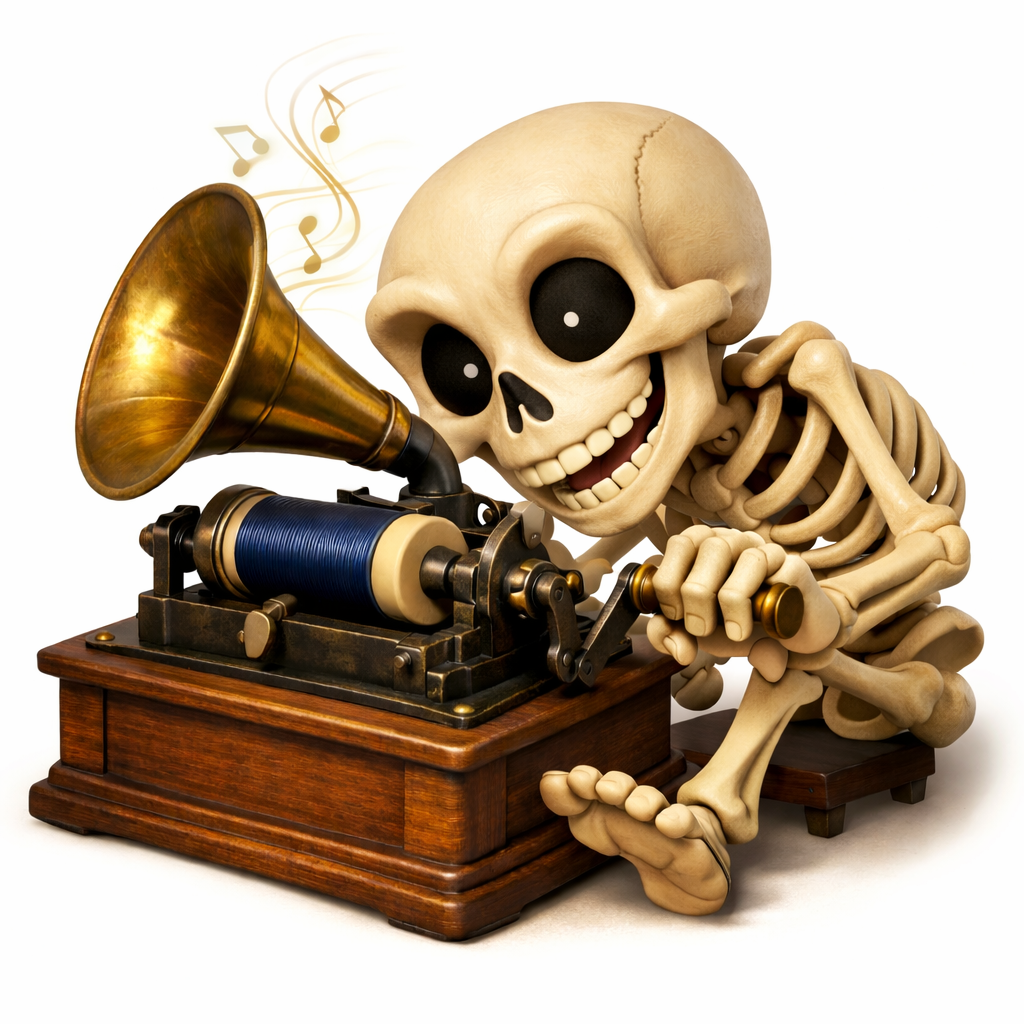
This is the story of how sound first learned to stick around.
Tin Foil and Lightning in a Bottle
In 1877, Thomas Edison unveiled something that felt less like engineering and more like sorcery. His phonograph could do two things no machine had ever reliably done before: capture sound and play it back.
The medium? A rotating cylinder wrapped in tin foil. A stylus scratched vibrations into the surface. Crank it again, and the machine spoke back.
People didn’t quite believe it. Public demonstrations were met with awe, suspicion, and occasional accusations of fraud. Voices coming out of a machine? Preposterous. Witchcraft, possibly.
The tin-foil cylinder was astonishing—and terrible. It wore out almost immediately. Each recording was a one-off. Play it a handful of times and it collapsed into metallic mush. Sound quality was… generous to call “sound-adjacent.”
But it worked. And that was enough.
Tin foil wasn’t the future—it was proof that a future existed.
Wax Makes It Real
Enter Alexander Graham Bell, along with Chichester Bell and Charles Sumner Tainter, who took Edison’s noisy miracle and made it practical. By the 1880s, tin foil gave way to wax, and the Graphophone was born.
Wax cylinders captured more detail, more warmth, more life. Voices sounded human. Instruments stopped fighting each other. The machine didn’t just repeat sound—it remembered it.
Even better, wax could be refined, shaved, reused, and eventually molded. By the turn of the century, recordings could be duplicated. For the first time, sound could be mass-produced.
That’s not a technical footnote. That’s an earthquake.
Companies like Edison Phonograph Company and Columbia Records built catalogs. Musicians became recording artists. Music stopped being something you had to be present for.
Sound went portable. Fame followed.
The Birth of Home Listening (and Everything That Came After)
Wax cylinders quietly rewired society.
You no longer needed a concert hall. Or a theater. Or a performer in the room. Music entered living spaces—parlors, apartments, boarding houses. The phonograph became furniture. Entertainment became domestic.
Artists reached audiences they would never meet. Families mailed each other voices. Politicians, educators, preachers, and hucksters all found uses for recorded sound. Language lessons. Poetry readings. Historical speeches. Therapy, even—long before anyone called it that.
This was the moment sound stopped being fleeting. It could now outlive the speaker.
A Slow Fade into the Archives
Wax cylinders didn’t die in a dramatic blaze. They were simply… out-engineered.
Flat discs were cheaper, tougher, easier to stack and ship. Playback times increased. Gramophones took over. By the early 20th century, cylinders were already becoming obsolete.
They lingered in offices and niche uses, then slipped quietly into history, but they didn’t quite vanish.
Today, wax cylinders sit in archives and museums, humming faintly with the past. They hold voices no one alive has ever met. Accents that no longer exist. Songs that were never written down. They are among the earliest true audio time capsules we have.
Modern engineers now digitize them—not to replace them, but to save what they contain before time finishes the job.
Why They Still Matter
Wax cylinders didn’t just start an industry. They forced us to ask questions we’re still arguing about:
- Who owns a recording?
- Who gets paid?
- What does it mean to preserve a performance?
They helped invent copyright law, home entertainment, recorded journalism, and the idea that art could be both intimate and mass-distributed. Most of all, they remind us that sound was once physical. Vulnerable. Temporary. A thing you could drop, damage, or lose forever.
In an age of infinite copies and disposable playlists, there’s something grounding about that.
The wax cylinder wasn’t perfect. It wasn’t durable. It wasn’t convenient. But it was human.
And everything we listen to today—every stream, every download, every perfectly preserved digital file—still traces its lineage back to those fragile spinning ghosts of sound.
Not bad for a lump of wax.